what does the wire to 3 prong dryer outlet look like
 Electrical Wire Size Required for Receptacles
How to choose the proper wire size for an electrical plug outlet or wall plug
- Mail a QUESTION or Comment about how to install and wire electrical outlets or receptacles in buildings.
InspectAPedia tolerates no conflicts of interest. We have no human relationship with advertisers, products, or services discussed at this website.
What size electrical wire should you apply when hooking upward an electric receptacle (wall plug or electrical outlet)?
Here we explain the selection of No. 14 or No. 12 copper wire for 15A and 20A electric circuits where receptacles are being wired.
This commodity series describes how to choose, locate, and wire an electric receptacle in a home. Electrical receptacles (also called electrical outlets or "plugs" or "sockets") are simple devices that are easy to install, merely there are details to go correct if you want to be prophylactic.
Watch out: if you are not trained in proper, code-legal, safe electrical wiring yous should know that making a mistake can kill someone or set the building on fire. Ameliorate to become help from a licensed, trained electrician.
This website provides data near a variety of electrical hazards in buildings, with articles focused on the inspection, detection, and reporting of electrical hazards and on proper electric repair methods for dangerous electrical conditions. Critique and content suggestions are invited. Credit is given to content editors and contributors.
We also provide an Article INDEX for this topic, or you can try the page top or bottom SEARCH BOX as a quick way to notice information you need.
What Size Electrical Wire Should I Utilise When Wiring an Electrical Outlet (Receptacle)?
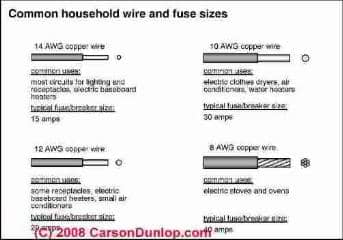
- The electric wire used for the receptacle circuit must be the proper type in size (thickness or estimate) and number of conductors for the ampacity of the electric excursion
- The electrical excursion must be properly protected by the correct fuse or circuit breaker
- For a 15-Amp circuit use #14 copper wire (or #12 copper-clad aluminum wire). The fuse or circuit breaker feeding this excursion is rated for 15 amps.
- For a 20-Amp circuit utilize #12 copper wire (or #10 copper-clad aluminum wire).The fuse or circuit breaker feeding this excursion is rated for 20 amps.
- For a 30-Amp circuit use #ten copper wire and a fuse or circuit billow rated for 30 Amps.
- For other wire sizes and a complete wire size table
see SE CABLE & Co-operative CIRCUIT WIRE SIZES vs AMPS - split up article
[Click to enlarge any image] Sketch courtesy of Carson Dunlop Associates a Toronto habitation inspection, report writing, and education company.
Annotation one: information technology's safe and OK to use a smaller (lower ampacity) fuse or circuit breaker, such every bit a 15-amp fuse protecting a circuit wired with #12 copper wire.
Note 2: it's generally rubber and OK to use a larger size electrical wire, and a larger wire size may in fact be required for longer wiring runs. Generally you want a 3% or less voltage drop beyond the wire from source to point of employ. For the U.Southward., electrical wire sizes vs. circuit ampacity are given in National Electric Code Table 310-16.
Sentinel out: in complex circuits that accept many connections inside a single junction box you could become into trouble: the number of connections that are allowed within an individual junction box depends on the wire size and the size of the box itself. And so increasing just the wire size could require that y'all employ a larger electrical box.
Electrical Conductors: Do I Need 2-Wires? 3-Wires? 2-Wires with Ground?
The electrical wire must take the proper number of conductors in modernistic electrical circuits used to wire receptacles (electrical outlets).
Typically an electrical receptacle is wired with two insulated wires and a bare ground wire, all 3 of which are encased in a plastic (NMC) or metal (BX) jacket.
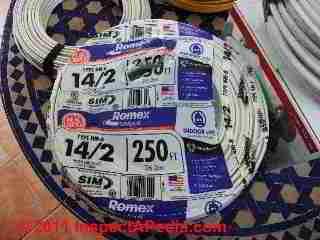
You'll see this wire labeled as fourteen/2 Type NM B with ground (photograph at left) or 14/2 Type NM C with ground.
Inside of the wire's capsule the individual conductcors are colour coded black, white, and bare (hot, netural, ground).
Details are at NUMBER of WIRE CONDUCTORS NEEDED
Also run across Electric Code Basics
and also Safety for ELECTRICAL INSPECTORS.
Question: how many electrical receptacles are allowed on a 20-amp circuit? How many receptacles on a 15-amp circuit?
 How many receptacles can be wired To one twenty amp circuit No. 12. Wire - John K.
Reply:
John K:
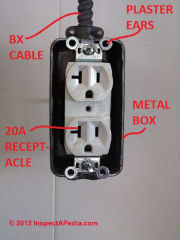
Our photo (left) shows a twenty-Amp electrical receptacle - you can recognize it past that horizontal opening that makes the left-hand slot wait similar the alphabetic character "T" on its side.
In general, the Electrical Code [NEC] allows
- 10 electric receptacles to be wired on a 15-Amp (#14 copper) wire excursion, and the Electrical Code [NEC] allows
- 13 receptacles on a xx-amp (#12 copper) wire circuit.
Watch out: When purchasing the receptacles to use on a 20A circuit, exist sure to likewise purchase receptacles that are themselves rated for 20Amp utilise.
You lot'll see that those least costly receptacles found in a big pile at building supply stores are more likely intended only for xv-Amp use.
Question: Wire size required for a 30A Wall Plug for an RV Power Drop? What about voltage driblet on the excursion?
2016/09/11 Scott Davidson said:
I would like to install a 30 amp 120 volt outlet to plug in my rv camper For the length of the run it says i should utilize number 8 /ii wire it is about 42 feet from console to where plug would be installed is this correct Thank you Scott
Reply: when to use a larger size electric wire for long wiring runs - continue voltage drib under 3%
Scott
Wire sizes vs amps vs run lengths are given in the National Electric Code Table 310-16. ( Allowable ampacitys of conductors ). [Consult The Electric Code for further details.]
Picket out: you lot do NOT want to provide 30 Amps to a typical electric receptacle ("outlet" or "wall plug") as devices connected to those wall receptacles look to be protected against overcurrent at either 15A or 20A; yous'll run across that a 20A receptacle looks a fleck different, having an extra slot.
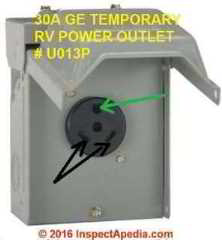
Above I illustrate a typical RV temporary outlet box for taking power to an RV. This is a GE unit of measurement sold at various electrical suppliers and building supply stores.
Another sort of 30A electrical receptacle and the wall plug that plugs into it uses a different design: you lot'll see that the openings in the receptacle are curved and the plug'south "prongs" are besides curved or in other designs the receptacle and mating plug employ an angled opening and prong.
Watch out: Do NOT simply run 30A to a typical wall receptacle.
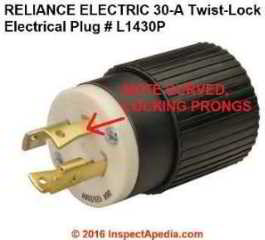
Typically a #x wire can handle 30A 120V loads and lengths such every bit what you lot draw. Tell me where y'all got the requirement for #8.
Yous're right that it's safer and sometimes required to go to a heavier wire gauge (#8) for longer runs.
If your installation permits a iii% voltage drib, then a typical wire calculator or voltage drop calculator (at that place is a plethora of them online) volition say y'all could have used a 42 foot length of #10, so #8 sounds prophylactic to me.
Lookout man out: when going to a larger wire size, depending on the number of wires and connections in the electrical boxes on the circuit, you may need to go to a larger electric box size to come across the wiring infinite requirements.
See Electric BOX SIZING Tabular array
Scout out also: ordinary electrical wire is not intended for use as an "extension cord" and is not intended for use being repeatedly plugged in and out nor left exposed and unsupported.
Watch out: finally, I note that you plan on running 8/two wire? Surely you mean viii/2 with ground, right?
Check with your electrical section about required permits and safety inspections.
Voltage Drib Reckoner for Long Wire Runs
I used both www.elec-toolbox.com/calculators/voltdrop.htm and Southwire; Southwire also has a nice voltage calculator and as a wire manufacturer, they of course have both an interest in proper wire utilize and engineers on staff.
Here's what Southwire'due south voltage drop calculator told us when we causeless the wire was 120V, 30A, 42 feet long, "underground / direct" though in conduit or overhead didn't change the upshot past much: all instances gave less than the typically-allowed maximum of 3% voltage drop.
1 conductors per phase utilizing a #10 Copper usher will limit the voltage drib to 2.21% or less when supplying 30.0 amps for 42 feet on a 120 volt organisation.
Electrical Engineering Details Provided by Southwire's Voltage Drop Calculator
- 30.0 Amps Rated ampacity of selected usher
- 1.1417 Ohms Resistance (Ohms per thou feet)
- 0.05 Ohms Reactance (Ohms per 1000 feet)
- 3.5999999999999996 volts maximum commanded voltage drop at 3%
- 2.644. Actual voltage drib loss at two.21% for the excursion
- 0.9 Power Factor
**Note to User: All ampacity values are taken from the Section of 310-15 of the NEC. The conductor characteristics are taken from Table 9 of the NEC
. The calculations used to determine the recommended conductor sizes for co-operative circuits are based on 60°C ampacity ratings for circuits rated 100 amps or less or marked for utilise with #14 AWG - #one AWG. Circuits rated over 100 amps or marked for conductors larger than #ane AWG are adamant using 75°C ampacity ratings.
Calculations to decide service and feeder conductor sizes are based on overcurrent device ratings rather than actual expected loads which are conservative and may yield oversized conductors.
No calculations accept into business relationship temperature correction factors or conductor de-rating.
This voltage drop figurer is applicable only to NEC applications. It does not optimize conductor sizes for several different loads at various points in a circuit. The full combined load and length of the circuit must be used.
Consult with an engineer if your application requires more circuitous engineering calculations. - www.southwire.com/support/voltage-drop-calculator.htm
Reader Q&A - likewise meet the FAQs series linked-to below
@Charles,
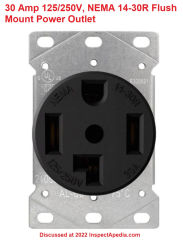
I am guessing you're describing wiring for a 30 Amp 125/250V, NEMA 14-30R Flush Mount Power Outlet, Single Direct Blade Range and Dryer Outlet Grounding, blazon device.
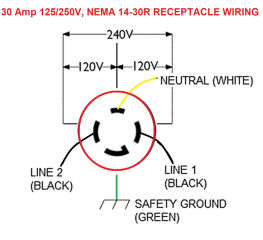
I don't know what wires you've run to the receptacle, so I am attaching a typical wiring diagram for a iv-prong receptacle.
You will see that in normal wiring the wires are
- Black 120V
- Black 120V
- White Neutral
- Dark-green Ground
Within the device connected to this receptacle, such as a dryer or range, use may exist made of both 120V power (choosing one of the black wires and using the neutral connector) AND 240V power (choosing the two black wires).
Now sometimes an electrician may brand use of an extra white wire equally a current-carrying conductor. Doing and so, she will indicate that the white wire in that case is Non a neutral wire, just that information technology carries current: by wrapping black electrical tape effectually the insulation near the ends of the wire wherever information technology is connected.
Here is a xxx Amp 125/250V, NEMA 14-30R Flush Mount Ability Outlet, Single Straight Blade Range and Dryer Outlet or receptacle, though in the photograph the ground is shown at the pinnacle of the epitome - dissimilar in the wiring diagram.
Can I utilize the white wire for power on a 10 awg two wire plus ground for a 30amp 4 prong receptacle
@Gregg Linville,
First, in a shop, you certainly don't want all of your receptacles on a single circuit or you may have trouble with overloading and tripping the billow.
So you probably want multiple circuits depending on what'southward being plugged in at those receptacles.
Information technology's a common practice for electricians to run a larger wire, for instance a number 10, to the more distant end of your shop to a junction box that then feeds number 12 wire to distribute receptacles in that area.
Depending on what you're connecting, you lot may need several of those.
Using 12 approximate wire 20 amp billow, instal 12 outlets over 55 feet, my shop is fourscore anxiety long what do I exercise to go the rest of the receptacles ran the additional 25 feet.
@nick,
a 240VAC appliance rated for 3750Watts will draw just a bit over 15A, and then need a 20A 240V excursion.
Now take a await at
SE Cablevision & Co-operative Excursion WIRE SIZES vs AMPS
where nosotros give tables of wire sizes and y'all'll see that 20A circuits apply #12 copper wire,
And while a 120V circuit would be limited to almost 50 ft , your 240V 20A #12 copper wire tin can run upwardly to 100 ft.
we have a food warmer model E305 240 volts unmarried stage rated at 3750 watts and I demand to run power 40 anxiety to the unit.
what size wire, size excursion and receptacle amps should I use to plug the foodwarner unit. Thank you lot
@Philip Logiurato, Start at:
ELECTRICAL RECEPTACLE CONNECTION DETAILS
To wire a duplex, the second receptacle is simply continued to the "LOAD" terminals on the first receptacle.
Allow us know if y'all accept additional questions.
How to install and wire electrical outlets in a basement. Preferably a double.
Thanks for replying. I'll use the 15Amp breaker so.
Although the ceiling calorie-free and fan volition be the only things ordinarily on that circuit, my business concern would exist that someone years from now would unknowingly plug in a hair dryer and/or an electric heater which might make a heavy load. I guess they would figure it out when the breaker tripped.
@Sam, it would be more prophylactic and normal wiring to protect a fourteen guess wire with a xv amp breaker, not a twenty amp.
Have a expect at the full current draw for everything on the circuit, almost likely you're well below 15 amps.
Originally fed calorie-free and exhaust fan switches with 14/2 from a 20 AMP billow in my half-bath. Nothing else on that excursion. At present I've decided I could use a receptacle on that circuit besides.
Would at that place exist a trouble if I installed a GFI receptacle along side those switches? Would the 14-2 exist sufficient?
Bill
thank you for the question;
No, I would non desire to run 14 guess wire on a 20A circuit; use #12 wire, even though at the receptacle you're plugging in a portable heater that uses #16 wire in its line cord and even though the heater itself may draw less than 20A;
Figure that other people will plug in who-knows-what into that receptacle over the life of the building; if it's protected by a 20A breaker it needs to fed by #12 wire.
On a 20 amp circit is information technology ok to splice a xiv estimate a 16 guess which powers a portable heater?
In adept electrical wiring practice your lighting and your electrical receptacles would exist on two split up circuits.
Both of them normally run on 15 amp switch is number 14 copper wire.
Of course you need electrical boxes and receptacles and switches and receptacle plates and switch plates. I can't say nothing virtually that links involved.
Lookout man out: if you're not familiar with proper and safe electrical wiring you tin can have the building fire or you tin be shocked or killed.
Trying do you run a wire from console box to my building to install four plugs and one switch for a light tin you aid me out with the materials needed
Kelan
A 15A circuit would, at normal wire lengths, use #xiv judge copper wire
What size strand wire should be use for a lite fixture using xv amp fuse
What strand wire should exist ran for a wall outlet that uses 15 amp fuse
Larry
Thank you for the electrical circuit load limitations assumptions question.
The short answer is no. When electric engineers and lawmaking writers specify the number of devices allowed on a circuit (e.m. the number of electrical receptacles or what yous're calling outlets) that number is based on an supposition of less than 100% loading.
Instead it'south based on the assumed full reasonable load in current or amps on the circuit.
For example a typical electrical receptacle is rated for either 15A or 20A maximum current draw. (Information technology's permitted to install a 20A receptacle on a 15A receptacle circuit by the way).
So let'south first plugging things in: if we plug in a typical minor electric heater into merely ONE electrical receptacle information technology'due south already sucking in electrical energy at near 11-13 Amps.
Now let's plug in a couple of floor lamps and a reckoner, easily drawing some other 2-iii Amps.
So at just 2 or 3 receptacles actually in utilize nosotros are already at the maximum that the circuit can operate safely - without overheating and risking a burn.
Now let's plug in one more electric heater, perhaps a small one cartoon 20A.
Retrieve we're analyzing a 15A electrical excursion - a string of receptacles.
Our little heater draws 9 amps.
And after only a very short fourth dimension the circuit billow will trip, shutting down that now-overloaded 15A circuit (that was trying to draw perchance 28 amps).
So unless we plugged in nothing more a few LED-bulbed lite fixtures at every excursion, nosotros never were running electrical devices continued to all of your 10 receptacles at one time.
OK so where does the limit on number of receptacles of x per circuit come from?
Engineers causeless a typical load of 1.5A per receptacle (that's maybe plugging in a calorie-free and some other pocket-size device).
If we describe a 15A receptacle circuit, we could plug in 10 such devices for a total of 15A and thus non exceed the excursion breaker'south 15A rating.
We'd be better off if that were a 20A circuit - to have a chip of margin since real live human beings don't retrieve about the amp rating of their devices when they plug stuff in.
Bottom line: a rule of thumb is to continue the number of electric receptacles on a excursion to 10 on a 15A circuit. On a 20A excursion you could run thirteen such receptacles without tripping the breaker right-off, but
for both 15A and 20A circuits the rule of thumb is a maximum of x receptacles per circuit.
Also see the U.S. National Electric Code NEC
NEC 210.23(A)(1) Branch circuits limiting whatsoever individual receptacle's load to 80% of the circuit'due south load rating
NEC 210.11(A) Number of circuits limited equally per 220.18 maximum load
NEC 210.xx(A) - maximum load on a overcurrent device is 125% of the continuous loads plus 100% of the not continuous loads
15 amp breaker circuit 14/2 wire.
Some say to express full number of outlets to 10, pregnant the full number of consistent in-use outlets, correct?
You either made a wiring error or you shorted 2 wires together or yous shorted one of your wires to ground
I installed a outlet ran wire back to fuse panel 12/2 wire 20 amp breaker twenty amp outlet. Information technology blew the breaker. What did I practise wrong
Daniel:
In general it'south "safe" to use a larger wire-size than required and the smallest fuse or breaker ampacity that the equipment volition permit.
A two horsepower electric motor running on 208V draws around thirteen.2A to 13.8 Amps if the motor is single-phase.
A three-phase electric motor on a 208V circuit volition draw near 5 Amps, so you are well within normal limits.
Spotter out: however to be certain that your electrical boxes on the circuit are large plenty to hold the #10 4-usher wire splices and to stay within code. The box fill up codes set limits. If y'all are in the U.S., see the Us NEC Table 314.16(A).
For example: if you're using a iv-inch foursquare electric box you can (in general) use a maximum seven (7) electric conductors in that box.
I desire to run a 220 outlet to a 2HP 3PH motor, through a AC Motor Speed Controller, for xxx feet. Am I safe in using a 15Amp breaker and #10 copper 4 usher wire.
I can't say, William. What's the 12/2 existing length and usage?
I want to run power 600 feet to my pond. I plan to use 10/two fort the 600 ft run and splice into a pump house light circuit with two lights at this time . Will ability a calorie-free and fan at pond. Amp draw will exist no more than 3 amps. Tin can I splice 10/2 into existing 12/ii safely?
CJ
Why not run a sufficiently-large cable into a junction box that then feeds through a spliced-on #12 copper wire to the receptacle.
What do i use when running 100 feet from my garage billow panel to my gazebo.,for three 120v receptacles.?...#half dozen cable is too big to utilize on 20amp receptacle ,and so ho was practise i exercise this?
Hh
Thanks for the interesting wiring question.
No i with any experience would pretend that they could tell y'all for sure what an arbitrary wire is when found in old House wiring as people do all kinds of things over the life of the edifice.
Therefore it occurred to me that it could exist an added ground wire. A little scrap of testing with a voltmeter or digital multimeter should tell us whether the wire is hot, neutral, or footing.
I take a dwelling that was built in the early 1900'southward. I am remodeling the bath and ran into an electrical wire that I am non familiar with. I have two wall sconces and I want merely one vanity light over the bathroom mirror. The electrical wire for the old sconces is coming from the ceiling so I have plenty of wire to do what I want without running new wire.
But in that location is a small round white wire too coming into the old box that I have never run across earlier and it is coming from beneath, so there is not enough wire to attain the new calorie-free fixture. The wire is printed with "Code Class 14 600V R" on it. What is this wire?
Bed
I don't know what 212 wire nor three-bundle, is nor what Baer Black Coated wire is - sad, possibly y'all can analyze those terms or attach a photo (ane per comment)
but in general, when a receptacle or light fixture is "dead" the electrician will bank check
- for a blown fuse or tripped excursion billow
- for a bad electrical switch
- for a bad electrical connectedness right at the fixture or electrical junction box
and if those are not needing repair she will cheque upstream in the circuit bringing ability to the failed device, looking for a loose or bad connector
Watch out: if you are not trained in proper and safe electrical work y'all could start a building fire or be shocked or killed - so hiring an electrician may be warranted.
I have 212 wire in my bed room conduct copper coated blackness and coated white I take no power how can I prepare this
Betimes
A typical dwelling heating pad draws xx, xl, or 60 Watts -
On a 120VAC excursion 60 Watts draws nigh 1/2 Amp or 0.5 Amps
A typical dwelling 15Amp excursion uses #fourteen copper wiring.
So it's fine to make normal use of a home heating pad on a residential 15Amp circuit.
The event with plugging the heating into a floor receptacle is moot if the floor receptacle is properly installed, wired, and protected against over current (that is fused for 15A on your #fourteen wire circuit)
Provided there is some common sense applied similar:
- be sure there'south no trip hazard
- be sure nobody is going to walk on, step on, or place something over the floor receptacle (damaging the line cord, plug, or receptacle) or covering the receptacle cover (say with a coating) would of grade risk a fire.
- don't strength a 3-prong wall plug into a 2-prong receptacle
- Don't utilize an older heating pad that lacks a temperature command and that on High can start a fire
- Don't use a heating pad that is worn or damaged or whose wire or plug is worn or damaged
- Don't use a heating pad that has no automatic shutoff or whose shutoff isn't working
- Don't overload the circuit into which the heating pad is connected
Tin a heating pad be plugged into a flooring receptacle wired with # 14 wiring.
Cheers for a great question, Rog and i that comes upwardly from fourth dimension to time.
In general it is e'er "safety" to utilise a larger diameter or gauge wire than the excursion ampacity would require.
Yet you lot tin can run across more subtle trouble.
The larger wire is harder to install and can be difficult or in some cases even impossible to connect to some devices such equally receptacles or switches whose terminals are designed for #xiv or #12 copper wire.
In improver, the required (by electric codes) space in the electrical boxes to permit safe wiring is increased when the wire sizes are larger.
Take a await at
ELECTRICAL JUNCTION BOX TYPES
and you will observe a Table of Electric Box Sizes vs Number of Wires Allowed based on the U.Due south. NEC Table 314.16 (A) Metal Electrical Boxes for Devices
and in that tabular array pay attention to
NEC 314.16(B) Electrical Box Volume Required Per Usher (wire)
In that location yous'll see that while you need
2.25 cu.in. per #12 wire that will be in the box
you lot will demand
2.5 cu.in. per #10 wire that volition be in the box.
Cheque the sizes of your electric boxes.
That same article includes tips on solutions if you lot need more than wiring space or more cubic inches.
Can I apply #ten to feed a 20 amp circuit with 5 outlets and lighting
Cleta
Normally a xv amp electrical receptacle circuit is wired with number xiv copper wire.
Sentinel out, even if you're permitted to do electrical work yourself where you live, almost probable that work needs to exist done with a permit and with inspections by your local electrical inspector. Don't treat that as an inconvenience. It's an important safety factor.
Watch out also, if you lot're not familiar with proper and safe electric wiring you could burn downward the edifice, be shocked, or exist killed.
I am trying to redo electrical to plugins I am non sure what gauge wire
...
Continue reading at SE CABLE & Co-operative CIRCUIT WIRE SIZES vs AMPS - complete table of wire sizes, gauges, uses for buildings, or select a topic from the closely-related articles beneath, or come across the consummate ARTICLE INDEX.
Or see WIRE SIZE FAQs - questions & answers posted originally at this page.
Or come across these
Recommended Articles
- NUMBER of WIRE CONDUCTORS needed
- COPPER-CLAD ALUMINUM WIRE
- SE Cablevision & Co-operative Circuit WIRE SIZES vs AMPS - wire sizes for branch circuits, short & long runs, & for service entry cables
- SPLICING Electrical WIRES
- UNDERGROUND SERVICE LATERALS - wire sizing guidelines
Suggested citation for this web page
SIZE of WIRE REQUIRED for Electric RECEPTACLES at InspectApedia.com - online encyclopedia of building & environmental inspection, testing, diagnosis, repair, & problem prevention advice.
Or see this
INDEX to RELATED ARTICLES: Article Index to ELECTRICAL INSPECTION & TESTING
Or utilise the SEARCH BOX found beneath to Ask a Question or Search InspectApedia
...
Inquire a Question or Search InspectApedia
Questions & answers or comments about how to install and wire electrical outlets or receptacles in buildings.
Try the search box only below, or if you prefer, post a question or comment in the Comments box below and nosotros volition respond promptly.
Search the InspectApedia website
Note: appearance of your Comment below may be delayed: if your annotate contains an image, spider web link, or text that looks to the software equally if it might be a web link, your posting will appear later on it has been approved by a moderator. Apologies for the delay.
Technical Reviewers & References
Click to Bear witness or Hide Citations & References
Publisher InspectApedia.com - Daniel Friedman
stephensseaut1949.blogspot.com
Source: https://inspectapedia.com/electric/Electrical_Outlet_Wire_Size.php
0 Response to "what does the wire to 3 prong dryer outlet look like"
Postar um comentário