Good Obs Stream Bitrate for Streaming Bad Upload
Table of content:
- How to summate your bitrate
- Example-adding
- Table of different upload-speeds with resolutions and presets
- Presets: Screenshot-comparison
- Formulae
- Some notes
- Concluding words
How to calculate your bitrate:
Go to: world wide web.testmy.net and perform a upload-speed-test.
Y'all have to proceed the bitrate for your game and your audio in mind, likewise some room for spiking.
Y'all want to use around 70 % to lxxx % of your bitrate, next steps give you further communication.
I recommend ALWAYS using mono, unless you have a high enough upload speed for don't caring about the extra file size or y'all actually need to have the difference betwixt right and left channel.
Note: Mono volition give yous improve quality than stereo at same bitrates, because there is only 1 channel to encode compared to the 2 channels of stereo.
And then you lot have to subtract the speed you want to safe for your game. Likewise you should accept a few bites left for when OBS spikes at the bitrate.
Example-calculation:
Y'all have, like me, an upload of one Mbit or roughly k Kbit/s. I think audio quality beneath 64 Kbit/s is way too bad to listen to, so I took this for my stream. For me I establish out, that I need around 100 Kbit/south left for my game. Furthermore OBS' bandwidth usage varies around 35 Kbit/s to a higher place and beneath the targeted bitrate.
So allow's calculate:
1000 (Upload.speed)
- 100 (Game/Internet)
- 64 (Audio)
801 (Bitrate)
This is the bitrate, you want to use for video-encoding.
In fact, that's pretty much exactly the bitrate I am using, which is 800 Kbit/s.
This might differ a picayune fleck for anybody, but it's definitely a skilful starting betoken. If y'all confront lags in your game, but lower the bitrate 50 Kbit/s. If information technology'south okay, yous tin either go along that or try like 775 Kbit/s and and then on...
Table with resolutions
The bitrate in the top is the bitrate we only calculated above.
The slower the preset, the college the CPU-usage.
Every bit you tin can see in the "size in %"-section, presets beneath "veryfast" don't requite a real advantage in the actual bitrate you need for a specific resolution, they volition even need a slightly higher bitrate, simply will give an increase in encoding-quality, even though the difference might not be worth it in some cases.
If you lot want to attempt slower presets, go along track of your CPU!
You should attempt framerates like 24, 25, xxx and other common framerates.
Considering I assumed a relatively loftier impact in bitrate for different framerates, y'all might be able to squeeze out a few more fps than in the tabular array (excepting veryfast 360p at 700 kbit/s), but going with college framerates could cause a more than done-out stream at motion-scenes, and so picking these settings should be safe to provide a relatively abiding quality while moving.
Also effort to utilize Lanczos or Bicubic filter for downscaling if possible, because it will provide much more sharpness for low performance cost!
Note: Lanczos is frequently told to exist the sharpening-filter, considering information technology kind of overshapens the images. In my personal stance, at 540p the Bicubic looks better, but this is just a preference!
Presets: Screenshot-Comparison
Here are some screenshots. They are all at exactly the same settings except the preset.
These are all 432p @ thirty fps and 800 Kbit/s video-bitrate, profile is set up to high, rest is default.
I've added ultrafast, so you can see, why you shouldn't use presets faster than veryfast.







The differences are minor, but you can observe an increase in item and sharpness. (Y'all can run into the differences best, if y'all compare the workers.)
Peculiarly if you look at the right worker, you come across the line on the ground being cut through for veryfast and faster.
An other practiced signal to look at is the outline of the building or the number to a higher place the edifice/ betwixt the i worker and the edifice.
Y'all can discover, that the quality-differences between veryfast and faster also as betwixt faster and fast seem to exist the biggest
.
(virtually of your systems should be able to handle this, due to the low resolution we are using.)
Simply again: Keep rail of your CPU, while testing the slower presets!
Formulae:
If you desire to calculate on your own, yous tin can either utilize my table (I started at 360p with 30 FPS and a Bandwidth of 700 Kbit/s with veryfast for a very good stability) or you have to figure out an ain setting with a certain bandwidth, resolution and FPS, which looks fine to you.
Notwithstanding, here are the formulae:
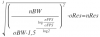
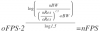

nBW (when on the right on the equality-sigh) = needed bandwidth
nBW (when in the formula) = new bandwidth (if you have a faster connexion than your starting point)
nRes = new resolution
nFPS = new FPS
oBW = one-time bandwidth
oRes = old resolution
o FPS = old FPS
Like written in the table, these are settings for mid-motility games, like RTS. If you are playing a low-move game, you might exist able to become away with the settings for your calculated bitrate+100 Kbit/south, for high-motion games the contrary.
Also I did cut some resolutions and presets, because they are not every bit „good" as the others. (They are not sufficient for these bitrates or take too much functioning) I tried to deliver a guide containing as much detail as possible and needed, because there are no sufficient guides out there for low bitrates in my opinion. All these is from testing, computing and research. The formulae I mainly used are: qval, 3/4-rule and principle of proportionality
(I tin provide the open-office-sheet, if you want to calculate different bitrates and/or resolutions yourself.)
Final words:
I was struggling, finding the correct settings for my stream and virtually of the "guides" on the cyberspace for my low upload speed didn't convince me at all.
So later the couple of weeks of reading, testing and calculating, I decided to practise a brusque guide on my own, which contains the most important stuff for nearly users, non going as well deep into the thing.
These settings might differ individualy, depending on your exact upload-speed, stability and your system (not simply the hardware, only the software, too).
And so yous might desire to adjust a piddling bit here.
This should assist yous, finding the correct settings rather and so only tell you, what to utilise.
If there are any mistakes, as well in content as in language too, you are welcome to transport me a PM, so I tin can correct them.
I promise, this could help y'all guys.
stephensseaut1949.blogspot.com
Source: https://obsproject.com/forum/resources/low-upload-speed-how-to-find-the-right-settings.185/
0 Response to "Good Obs Stream Bitrate for Streaming Bad Upload"
Postar um comentário